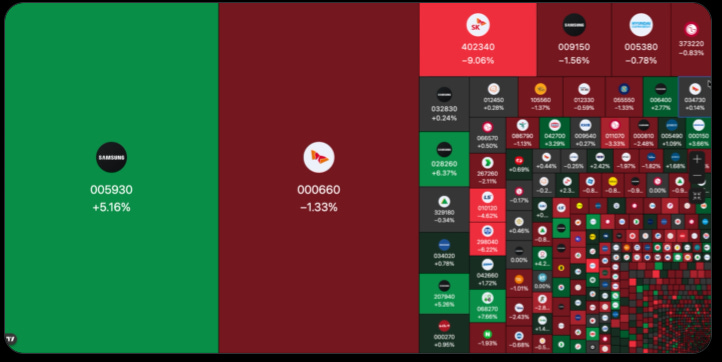
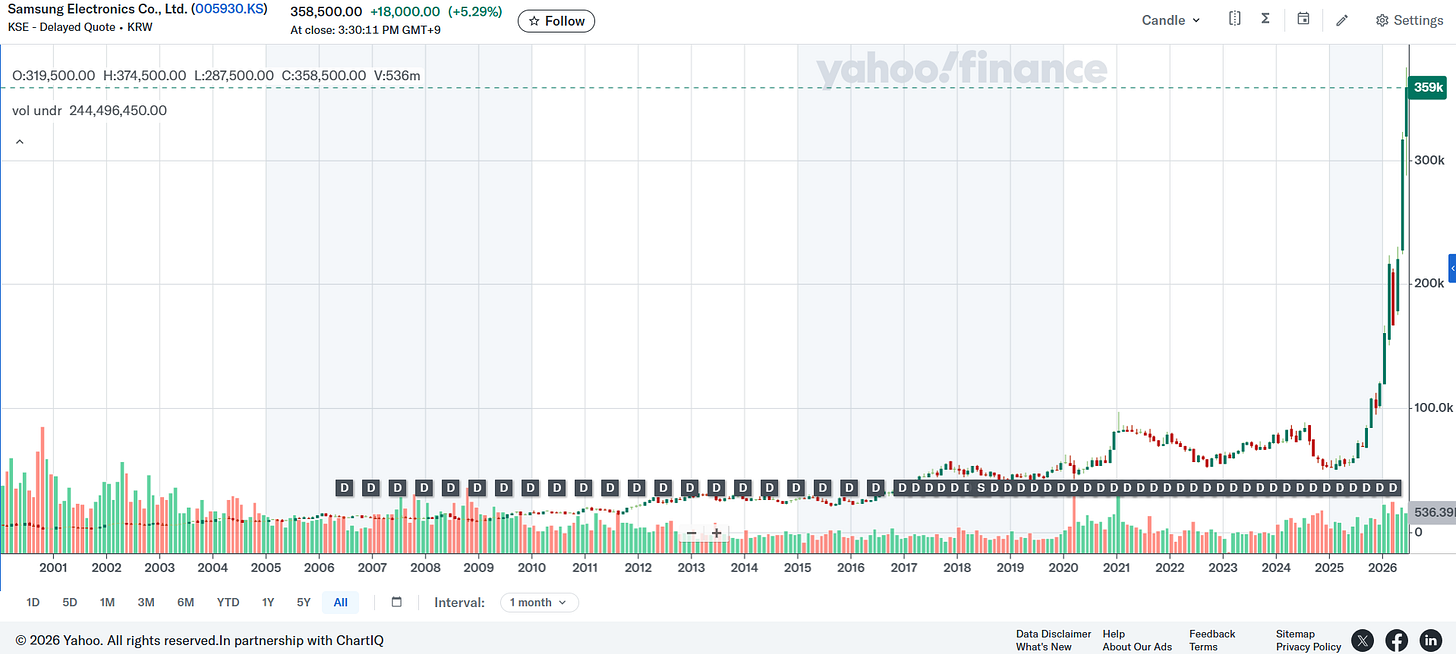
However, its AI related Korean stocks that have been getting all the attention with the bears over at ZeroHedge in particular being the most breathless with their reporting on their recent volatility:
Early last night, just around the time Korean stocks opened at a new all time high, we highlighted an article in Korea’s Chosun Biz [SK하이닉스, HBM4 생산 속도조절… ‘공급 부족’ 범용 D램 늘려 추가 수익 모색], which eventually became the catalyst for the sharp repricing lower of memory stocks – and since memory stocks account for about 60% of the Kospi, sparked the 10% crash in the South Korean market which culminated with a mandatory halt of trading – and sparked a risk off wave around the globe.
As both CNBC and Bloomberg write this morning, “traders are pointing to a South Korean media report saying SK Hynix is slowing expansion of AI memory chip production and shifting emphasis to commodity DRAM.”
The Kospi closed down 10%, with SK Hynix and Samsung both sliding more than 12% after a local report said the former was slowing expansion of its AI memory chip production to emphasize the cheaper DRAM components.
The prior concern was not about fundamentals alone, but about flow exhaustion
Regulatory pushback on single-stock leveraged ETFs is affecting sentiment at a sensitive time
Pension rebalancing is turning a key domestic anchor buyer into near-term supply
Profit-taking ahead of Micron earnings pressured memory/AI trades further
Again, fundamentals are still intact
Conclusion
KOREAN MARKET IS STILL STRUGGLING 🚨
KOSPI is up +0.64% today, adding roughly ₩50 TRILLION.
But Samsung alone added around ₩110 TRILLION while SK Hynix wiped out about ₩18 TRILLION.
For many years, Koreans were bitcoin’s best friend.
After bitcoin emerged about a decade ago as the asset class with the most pronounced momentum – both to the upside and the downside – Korea’s daytrading army, famous for being totally unable to do any fundamental valuation analysis but legendary for its wilnningness to piggyback on any momentum with suicidal leverage, became enamored with bitcoin and the result were face-ripping meltups and heartstopping crashes, a daily breathless rollercoaster where 10% moves in hours if not minutes had become the norm.
But then, last September something snapped. After bitcoin had tracked Korea’s Kospi index closely for years, the two series – formerly joined at the hips for years – diverged and went their separate ways, the Kospi soaring to never before seen levels, while bitcoin stagnated, shrinking ever lower as its former momentum-addicted traders abandoned it for something shinier, and with much more momentum: memory stocks.
A growing number of Koreans in their 50s and 60s, a generation traditionally associated with conservative investments like fixed deposits and real estate, are now embracing leveraged equity speculation funded through debt.
According to the Financial Supervisory Service, investors aged 50 and older accounted for more than 60% of the 27.2 trillion won ($18.5 billion) margin loan balance at Korea’s top 10 brokerages during Q1, more than double last year’s level. (Full The Korean Times article from earlier this month: Record-breaking rally draws older Koreans into riskier leveraged investing).
KOSPI continues behaving like the purest expression of the global AI melt-up. Every tiny wobble keeps getting violently bought, upside panic remains extreme, and the same reflexive flows that powered the vertical squeeze higher still show few signs of exhaustion.
The remarkable part is that positioning and momentum still do not look fully stretched yet. RSI levels cooled sharply during the brief pullback earlier this week, foreigners continue selling into the rally, and yet KOSPI, SK Hynix (KRX: 000660) and SK Hynix (KRX: 000660) keep ripping higher anyway.
South Korea’s stock market boom, driven by a global frenzy over artificial intelligence (AI) chips, is delivering hefty gains for Chinese investors piling into cross-border semiconductor funds.
The benchmark Kospi index has surged more than 80% this year to record highs, powered largely by chip giants c and SK Hynix (KRX: 000660), which together account for more than 40% of the index. The rally has pushed South Korea past the U.K. and Canada to become the world’s seventh-largest equity market.
The surge has spilled into China’s cross-border investment market, where investors are scrambling for overseas AI exposure through Qualified Domestic Institutional Investor (QDII) funds.
However, as we noted earlier this week when we pointed out the unprecedented pile up in the Korea ETF which was virtually identical to what happened in silver in January, just before the commodity crashed, the euphoric investor pile up in the main Korean index was screaming a “get me out of here” warning…
To be sure, as we also warned previously, there were clear signs of trouble even before this week: foreign funds that had spurred the market for much of last year abruptly turned net sellers in February, dumping a record amount of Korean stocks…
The Korean market also hiccupped when politicians started talking about sharing AI profits with all Koreans:
South Korea should share the profits generated by the artificial intelligence boom with all its citizens, its presidential policy chief said, sending shares in the country’s memory chipmakers lower.
In a Facebook post on Monday, Kim Yong-beom floated the idea of redistributing some of the soaring profits of Korea’s chipmakers after the market value of Samsung Electronics topped $1tn last week and shares in SK Hynix nearly tripled this year.
KOSPI declined by 2.3% on Monday (11 May), mainly due to concerns about imposing “national dividend” for excess profits from AI/semiconductor related companies in Korea (Samsung Electronics (KRX: 005930 / 005935 / LON: BC94 / FRA: SSUN / OTCMKTS: SSNLF) and SK Hynix (KRX: 000660)).
In the near term (1-2 years), it is highly UNLIKELY for the Korean government to suddenly provide national dividends for excess profits from major AI/semiconductor companies in Korea.
However, when the AGI becomes a reality, the idea of providing “national dividend” or by another name Universal Basic Income (UBI) could become a reality in 5-10 years.
Finally, here are some quick updates on the progress of reforms:
On 18 March, the Korean financial regulators announced that they are seeking to create a two-tier KOSDAQ market.
KOSDAQ will be divided into two tier system, including the premium market for large companies and the standard market for promising companies.
The introduction of a two-tier KOSDAQ system would have significant implications for valuation dynamics, raising valuations of companies included in the premium market and lowering valuations in standard market.
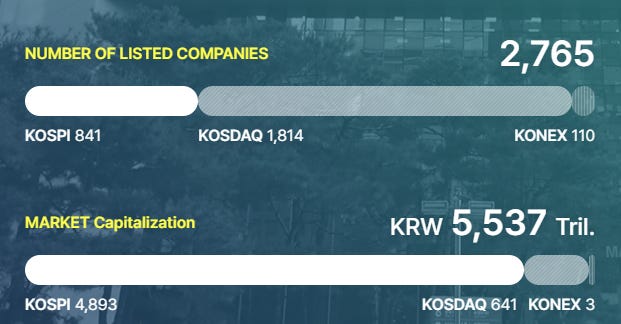
Number of companies and market caps of KOSPI and KOSDAQ exchange (as of 18 March 2026; Source: Korea Exchange)
Sharp swings are a reminder to Seoul that its reform agenda is incomplete
President Lee Jae Myung, who won elections last year, has prioritised stock market reforms to drive economic growth. He deserves credit for tackling the power of large companies. Last July a law passed making it a legal duty for directors to consider the interests of all shareholders rather than just the company. In late February an amendment was approved requiring companies to cancel newly acquired treasury shares within a year, ending a practice that investors say has helped owner families maintain control.
[Note: On desktop browsers, an autogenerated table of contents will appear on the left side linked to each stock. I will add those links below after publishing/emailing this post…]
Readers can decide whether these insights or summary about these stocks are accurate (format out usually various with the first output being in Chinese again…):
And as always, this post is provided for informational purposes only (and to make your life easier…). It does not constitute investment advice and/or a recommendation…
🔬 Research analysis (including articles/blog posts from fund managers, etc.); 🎥 Video; 🎙️ Podcast; 🎬Webinar; 📰 Newspaper/magazine article; 📯 Press release; 💻 Substack/blog/website article; ✅ Our own posts; 🗃️ Archived article; ⏰ Upcoming webinar or event; ⚠️ Disclosures or restricted access e.g. based on your location, investor status, etc.; 🇼 Wikipedia page; 🏷️ Tagged links to other posts about the stock.